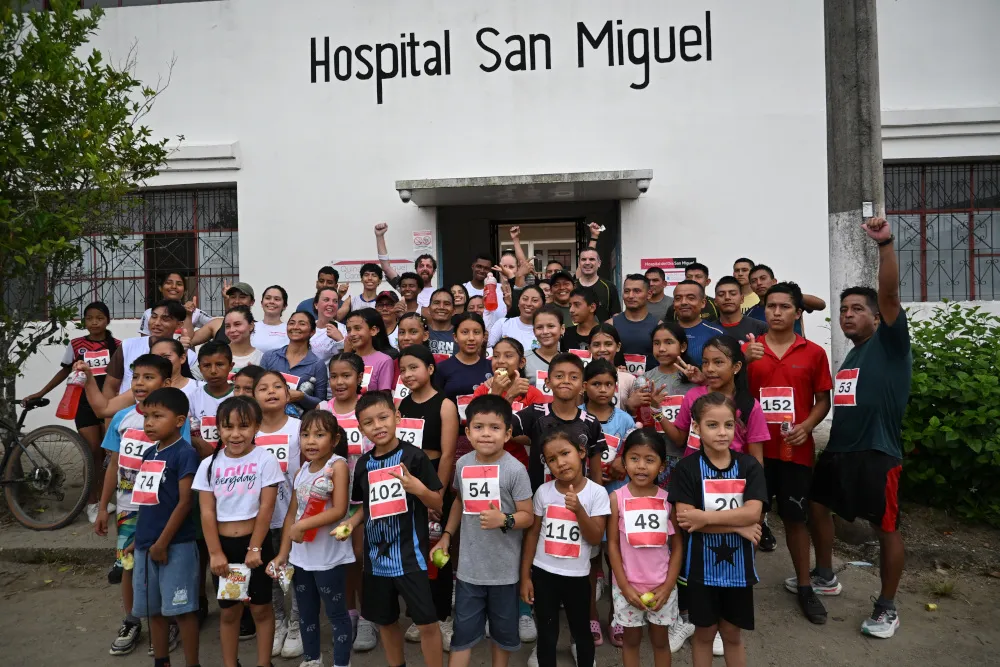
A hub is a place where a group of people run the Putumayo Loop together — on the same day as every other hub, anywhere in the world. As a hub organizer, you are the person who makes that happen locally.
You need no experience organizing events. A hub can be a group of friends running ten kilometers together, but it can also be a larger run with several distances and an official gathering location. Anything in between works just as well. Below you will find what we do, what we ask of you, and the practical things worth knowing.
What do we do?
Everything to do with the website, social media and the overall organization is on us:
- A place on the website. Your hub gets an entry with its location and the distances you are running.
- The registrations. Participants sign up through the Quina Care website. We record every registration and email you each time someone joins, so you know straight away who is taking part.
- An overview of your participants. We send you a list of everyone registered for your hub.
- General promotion. We give the run attention on our social media, and mention that there are hubs in various places that people can join.
- Promotional material. If you need something, we can supply our logo, a QR code to the sign-up page, photos from previous editions and general information about Quina Care.
- The general communication to all runners. We tell every participant what Quina Care stands for and what they are running for.
- A message in the run-up. Well before the day itself we email all participants several times: encouragement, a request to donate or find sponsors, and an invitation to take photos and video during the run. We turn those into a film afterwards.
What do you do?
You are the face of the run in your town. Concretely, we ask you to:
- Set out the route. You decide where the run goes and which distances you offer.
- Welcome the runners. Arrange a place for everyone to gather and make sure the day runs smoothly.
- Be the point of contact. For the participants in your hub, you are the person to turn to with questions.
- Handle the local practicalities. What time it starts, where the start is, where people can change — you know that, and we do not.
- Build on our email. Once we have sent a general message, it is a good moment to email your own participants a few days later.
- Encourage donating, finding sponsors and filming. We ask everyone, but it works better coming from you: you know your runners.
Promote it however suits you
There is no prescribed way to promote your hub. A few examples of what previous organizers did:
- Setting up a Facebook and/or Instagram page for the hub.
- Having flyers or posters made and distributing them at sports clubs, shops or the community center.
- Sharing the run's web page within your own network — via WhatsApp, Facebook, Instagram or LinkedIn — and asking your network to share it onward.
That last one takes little effort and often reaches surprisingly far. Want to do more, go ahead; want to keep it small and just take part with your running group or a few friends, that is equally welcome.
Practical information
How the organization fits together
The run has three layers. The run manager is the general point of contact for all hub organizers, and for participants who sign up without a hub. Below that, hub organizers are the point of contact for their own location. And below that are the participants. If you get stuck locally, the run manager is your first call.
When is it a hub?
The deciding criterion is the day: a hub runs on the day of the Putumayo Loop, and as far as possible around the same time. That is the whole idea — people all over the world running at once for the same cause. For the 2026 edition that is Sunday 18 October.
The distances need not be the same everywhere. You decide which ones you offer.
Would you rather run on another date, or do you have a completely different idea for raising money? Then it is not a hub but a fundraiser. We are just as glad to support that, and we will set up a dedicated page for you.
Permits
If you are setting up something on a larger scale, ask your local authority whether you need a permit or an exemption. It differs per municipality and per set-up, and it is unpleasant to find out late.
Costs and budget
There is in principle no budget. Everything we raise goes to the cause, and we want to subtract as little from it as possible.
If costs really are unavoidable — a municipal exemption, for instance — they can be reimbursed, but only if you discuss it with the run manager beforehand. Beyond that, always look first at whether something can be sponsored. If you want race numbers, a local printer willing to sponsor them is an elegant solution. Race numbers are not compulsory, incidentally.
Interested?
Get in touch with the run manager, Yvonne van der Ende, at yvonne.vanderende@quinacare.org. We will go through what is needed to put your hub on the map — literally.